Duffy Defends FAA Nationwide Ground Stop Decision
Duffy Defends FAA Nationwide Ground Stop Decision
Transportation Secretary Sean Duffy said he does not apologize for the Federal Aviation Administration’s nationwide ground stop, defending the agency’s decision to restrict departures after reporting system “instability.”
The FAA later lifted the restriction and said air travel had fully resumed. However, the end of a ground stop does not immediately restore every flight to its original schedule. Delays, cancellations, missed connections, aircraft repositioning, and crew disruptions can continue during the recovery period.
The incident renewed debate over aviation safety, accountability, FAA reliability, and federal investment in air traffic infrastructure. Available reports do not establish the instability’s technical cause, the exact duration of the ground stop, or the total number of affected passengers.
What Happened During the FAA Ground Stop?
The FAA Reported System “Instability”
The FAA lifted the nationwide ground stop after experiencing what it described as “instability.” A ground stop is an aviation control measure that temporarily prevents or limits aircraft departures under defined conditions. It allows the FAA and aviation operators to assess a potentially unstable, congested, or difficult-to-manage system.
A nationwide ground stop does not necessarily mean that all U.S. airspace is closed. Aircraft already in the air may continue under air traffic control instructions, and some flights may operate under specific restrictions. The immediate effect is generally felt through departure holds that can spread across the wider flight network.
The available reports do not identify whether the instability involved software, equipment, communications, staffing, maintenance, cybersecurity, or another operational factor. Those details require confirmation from the FAA or a complete original report.
Air Travel Eventually Resumed
The FAA said air travel fully resumed and characterized the disruption as largely over. Source 7
A lifted ground stop does not immediately restore normal operations. Commercial aviation relies on interconnected aircraft, crews, gates, airports, and passenger connections. When departures are held, aircraft can be out of position, crews can reach legal operating limits, gates can remain occupied, and passengers can miss onward flights.
Airlines may respond with rebookings, cancellations, schedule changes, and additional departure controls. The supplied reporting does not provide the following details:
- The exact start and end times.
- The total duration of the restriction.
- The number of delayed or canceled flights.
- The number of affected passengers.
- Airport-by-airport effects.
- The specific cause of the reported instability.
Why Did Sean Duffy Refuse to Apologize?
Duffy Defended the FAA’s Response
Duffy said he did not apologize for the FAA’s nationwide ground stop. His statement presented the restriction as a defensible operational decision rather than an action requiring an apology.
A safety-based defense generally rests on the argument that aviation officials must restrict traffic when they cannot confidently manage the system. From that perspective, a ground stop creates immediate inconvenience but may reduce the risk of operating a larger number of flights under uncertain conditions.
The available source summaries do not include Duffy’s full remarks or a detailed account of the FAA’s internal decision-making. They do not establish why officials selected a nationwide ground stop instead of a narrower restriction.
Duffy Faced Public Criticism
AOL reported that Duffy faced criticism from NBC News viewers after refusing to apologize for the ground stop. Source 5
The criticism reflects two competing public expectations. Travelers affected by a nationwide disruption may expect officials to acknowledge the financial and personal costs. Officials may view the ground stop as a necessary safety measure rather than an error requiring an apology.
Those positions can coexist. An official can defend an emergency safety decision while acknowledging the disruption experienced by passengers. An apology for inconvenience does not necessarily mean accepting responsibility for a technical failure or admitting that the ground stop was unjustified.
The supplied report does not establish the scale, content, or representative nature of the viewer criticism. Public reaction should therefore be distinguished from verified findings about FAA performance.
What Is a Nationwide Ground Stop?
A nationwide ground stop is a temporary restriction on aircraft departures across a broad portion of the United States. The FAA and air traffic control authorities use such measures to manage safety or capacity when the system cannot operate normally.
The purpose is to prevent more aircraft from entering a system that may be unstable or overloaded. The restriction gives controllers, airlines, technical teams, and airport operators time to assess conditions and coordinate a controlled recovery.
A ground stop differs from a complete closure of the national airspace system. Flights already airborne may continue, land, divert, or change course under instructions. The precise limits depend on the situation and the FAA’s directions.
Why Ground Stops Cause Widespread Delays
Commercial aviation operates as an interconnected network. One aircraft may complete several flights in one day, so an early delay can affect every later departure assigned to that aircraft.
The same pattern applies to crews and passengers. Pilots and flight attendants may be unable to reach their next assignments, passengers may miss connections, and airport gates may remain occupied longer than planned.
A nationwide restriction can therefore create effects beyond the initial stoppage. Once operations resume, airlines must locate aircraft, crews, and passengers and rebuild schedules while complying with safety, staffing, and airport constraints.
The FAA’s Explanation and Recovery
The FAA said air travel fully resumed and described the disruption as largely behind the country. Travelers should still check directly with their airlines because an FAA-wide recovery does not guarantee that every carrier has restored every route, aircraft rotation, or connection.
The available reports do not establish the technical source of the instability. They also do not confirm whether the incident involved equipment, software, communications systems, staffing, control-center operations, maintenance, cybersecurity, or another operational condition.
No supplied source confirms whether the FAA will conduct a formal investigation or publish a detailed after-action report. Conclusions about responsibility would be premature without verified findings.
Donald Trump Called for Additional FAA Funding
PBS reported that Donald Trump addressed the nationwide ground stop and called on Congress to provide additional funding for the FAA. Source 3
Additional funding could support air traffic control technology, staffing, maintenance, modernization, and aviation infrastructure. However, the funding request does not establish the cause of this specific disruption or show that additional funding would have prevented it.
The supplied reporting does not indicate that Congress approved new funding or identify the amount requested.
Safety, Accountability, and Public Confidence
Aviation authorities are expected to prioritize safe and controlled operations. If officials cannot confidently manage traffic, restricting departures may prevent a larger emergency. That rationale explains why Duffy defended the FAA’s decision.
A safety-based explanation does not eliminate the need for transparency. Passengers, airlines, aviation workers, and lawmakers need to understand what happened and whether corrective action is required.
Passengers may face missed connections, delayed arrivals, canceled travel plans, additional lodging or transportation costs, rebooking difficulties, and uncertainty about when flights will resume. Those consequences help explain why Duffy’s refusal to apologize became controversial.
A complete follow-up should explain:
- What caused the instability.
- How the FAA detected the problem.
- Why a nationwide restriction was necessary.
- How long the disruption lasted.
- How many flights and passengers were affected.
- What corrective measures will follow.
- Whether an independent review will occur.
What Passengers Should Do After a Ground Stop
Passengers affected by a nationwide ground stop should:
- Check the airline’s application or website before leaving for the airport.
- Confirm the latest departure time rather than relying on the original itinerary.
- Contact the airline about rebooking if a connection is no longer possible.
- Keep receipts for eligible expenses.
- Review the carrier’s disruption and reimbursement policies.
- Monitor the airline and FAA for continuing updates.
A lifted ground stop means that broad restrictions have ended. Individual flights may still operate late or be canceled while airlines restore their schedules.
Key Takeaways
- The FAA imposed a nationwide ground stop after reporting system “instability.”
- The agency later said air travel fully resumed.
- Transportation Secretary Sean Duffy said he did not apologize for the decision.
- Duffy faced criticism from NBC News viewers, according to AOL.
- Donald Trump called on Congress to provide additional FAA funding.
- Available reports do not establish the technical cause, duration, passenger count, or total number of affected flights.
- Further official investigation and reporting are needed before responsibility can be determined.
FAQ
What did the transportation secretary say about the FAA ground stop?
Sean Duffy said he did not apologize for the FAA’s nationwide ground stop and defended the decision despite criticism from NBC News viewers. Source 1
Why did the FAA impose a nationwide ground stop?
The FAA said it experienced “instability.” The supplied reports do not identify the specific technical or operational cause.
Did flights resume after the ground stop?
Yes. The FAA said air travel fully resumed, although individual flights could still have remained delayed while airlines restored normal schedules. Source 7
How long did the nationwide ground stop last?
The supplied source summaries do not provide a confirmed start time, end time, or total duration. Those details require confirmation from the FAA or a complete original report.
What did Donald Trump say about the disruption?
PBS reported that Trump addressed the ground stop and called on Congress to provide additional FAA funding. Source 3
What should passengers do after a ground stop?
Passengers should check their airline’s latest flight status, confirm rebooking options, keep receipts for eligible expenses, and monitor continuing updates. A lifted ground stop does not guarantee that every flight has returned to its original schedule.
Artikel Terkait
-
 Jensen Huang, AI Hype, and the Risk of Overconfidence
-
 Bessent Calls for a Dramatic Shakeup at Nvidia
-
 Anthropic IPO: A Test for the AI Investment Trade
-
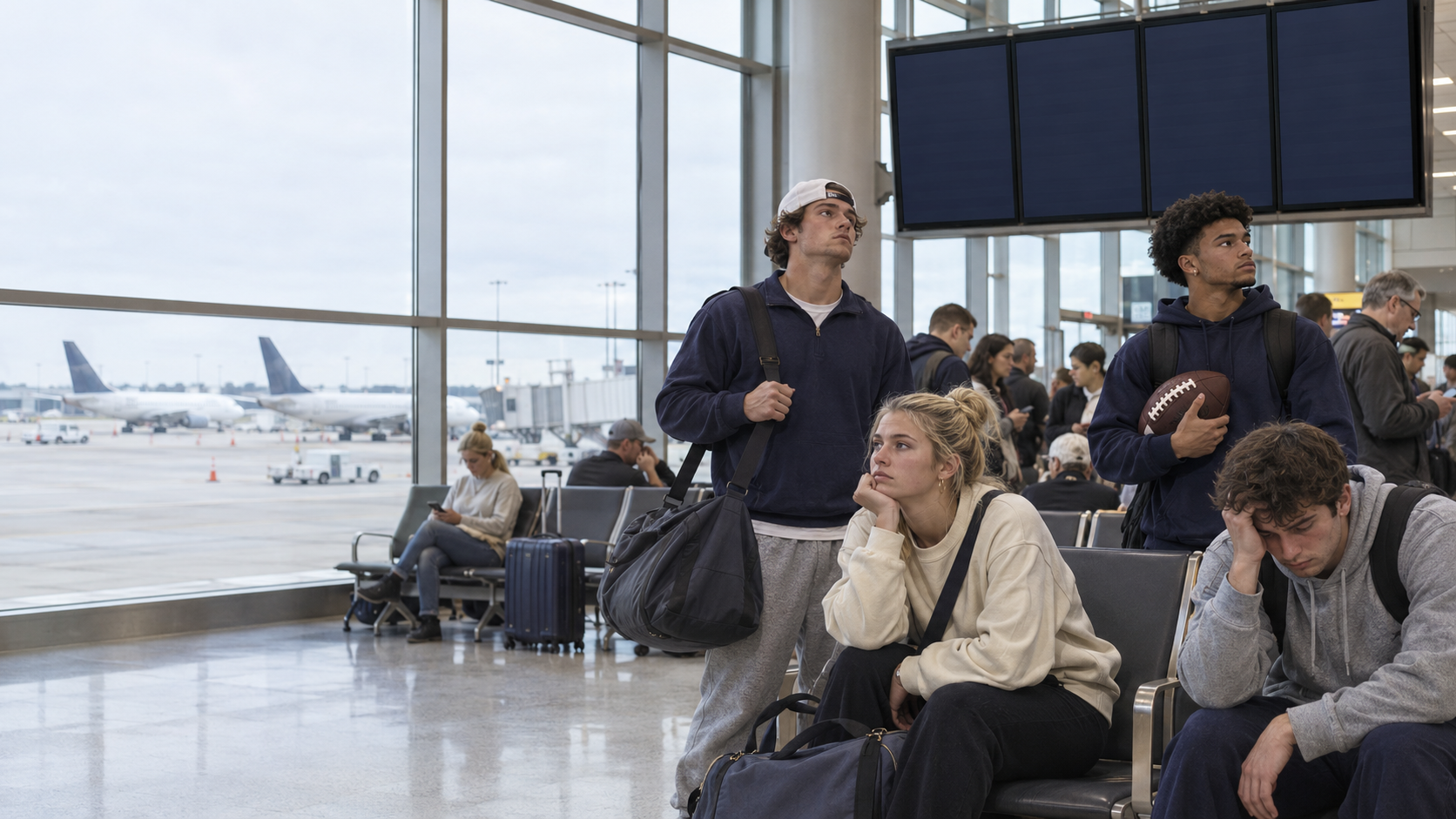 How the FAA Ground Stop Disrupted College Football Travel
-
 Are Everything’s Systems Breaking? Outages Explained
-
 Why Jensen Huang Is a Celebrity in Taiwan