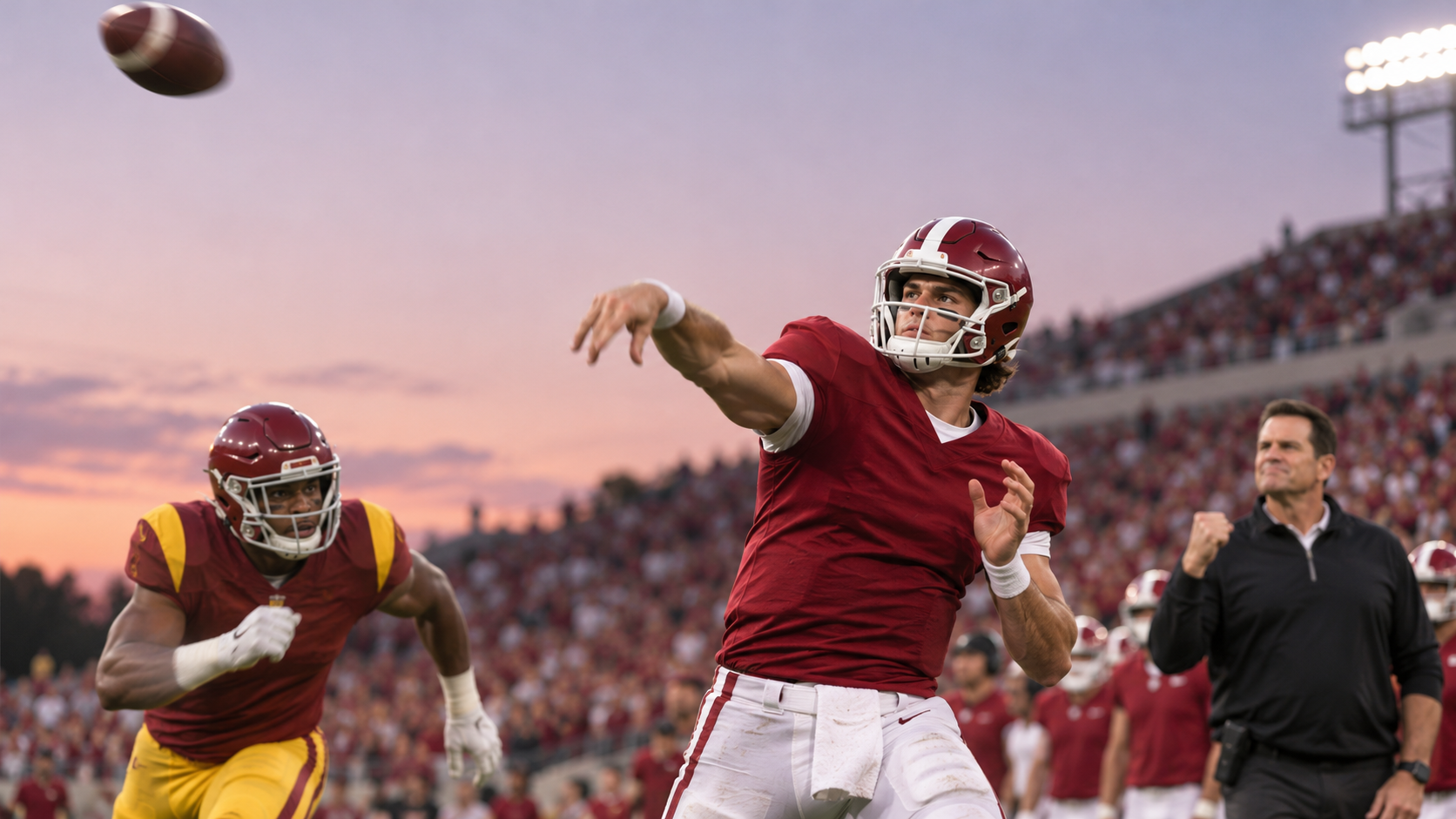
Texas Stuns LSU 22–21 on Manning's Late Touchdown
Texas Stuns LSU 22–21 on Arch Manning’s Final-Seconds Touchdown
Texas defeated LSU 22–21 after Arch Manning threw a touchdown in the final seconds, completing a dramatic comeback and dealing a major blow to the Tigers’ College Football Playoff hopes.
Manning’s performance was uneven. Reports described turnovers and questionable throws, but his final possession produced the game’s defining play: a touchdown that turned a one-point deficit into a one-point victory. Source 1
Texas won by a single point, and the margin defines the story. A two-score win would have been filed as a routine result. A one-point win decided on the last possession becomes a reference point for both programs: the play Texas will replay, and the play LSU will have to answer for.
The Final-Seconds Scoring Play
Texas entered the closing sequence needing a touchdown to overcome LSU’s lead. Manning led the rally and delivered the decisive scoring pass in the final seconds, according to the supplied reports. Source 7
The available summaries do not establish the touchdown’s distance, the receiver’s identity, the starting field position, or the exact time remaining. Those details should be confirmed through an official box score or play-by-play record. The central fact is clear: Texas needed one successful final possession, and Manning provided it.
The touchdown completed the comeback rather than merely adding to a strong performance. Texas stayed close enough to create a late opportunity, then executed when the game required a touchdown instead of a field goal.
That distinction carries real weight. Trailing by one, a field goal was not an option — a kick would have lost the game by a point or, at best, forced the same conclusion. The offense had to reach the end zone, against a defense that knew a touchdown beat it and a field goal did not. Play-calling narrows in that situation: the defense can sit on the goal line and force contested throws into tight space. Manning’s final pass had to beat that compressed picture.
Why the Clock Changes the Calculation
When a team needs a touchdown in the final seconds, three constraints stack at once: the clock, the down count, and the sideline. Each incomplete pass stops the clock, which helps the offense but burns a down. Each completion in the middle of the field keeps the clock moving, which helps the defense. The offense must therefore mix boundary throws, spikes, and timeouts without knowing which combination the defense will allow.
The supplied reports confirm the outcome, not the mechanics of that sequence. Anyone reconstructing the drive should rely on the official play-by-play rather than inference, because a final drive’s shape — how many plays, how much time consumed, whether a timeout was used — determines how impressive the execution actually was.
Manning Overcame Mistakes
Manning’s performance was not flawless. Reports state that he committed turnovers or made questionable throws before recovering to deliver the decisive touchdown. Source 9
The winning touchdown does not erase those mistakes. It changes their place in the final narrative. In a one-point victory, the final scoring play becomes the lasting image, while the turnovers remain areas for correction.
Yahoo Sports reportedly summarized criticism from Shannon Sharpe, who objected to Manning “throwing ish up” during the game. The remark focused on Manning’s throwing decisions or execution, although its full context should be verified. Source 3
The balanced assessment is straightforward: Manning made mistakes, drew criticism, and still made the game’s most important play.
Why One Drive Does Not Settle a Quarterback Evaluation
A single possession is the smallest sample in football, and it is also the most visible. Clutch play matters, but evaluation depends on repeatability: does the same decision-making hold on first-and-10 in the second quarter, when no urgency forces the throw? Turnovers are usually decision errors or accuracy errors, and both tend to recur unless the underlying process changes.
The honest read of this game is narrow. Manning demonstrated that a late deficit did not produce panic, and that he could produce the required throw with the game compressed. He did not demonstrate that the turnovers were a one-off. Both statements can be true, and the coverage that picks only one is incomplete.
LSU’s Playoff Hopes Take a Major Hit
LSU could not protect its one-point advantage, while Texas gained a signature victory built on late-game execution. The loss carried consequences beyond the scoreboard because the Tigers received no postseason credit for remaining competitive.
Reports described the defeat as damaging or eliminating LSU’s College Football Playoff hopes. The exact status should be confirmed through official standings, conference records, remaining games, and selection information. “Eliminated” can mean mathematical elimination or practical removal from serious contention. Source 5
The safest conclusion is that LSU’s CFP position was severely damaged. A one-point loss carries the same record penalty as a blowout, even when the performance gap is small.
Why Close Losses Cost More Than They Feel Like Costing
Selection decisions weigh résumés, not margins. A one-point loss and a four-touchdown loss enter the record identically, so the moral value of competitiveness does not transfer into the standings. What does transfer is the count of defeats and the quality of wins.
That asymmetry explains why late losses sting disproportionately. The team that loses narrowly can argue it was a few plays from a different season; the committee, conference standings, and tiebreakers only see the result. Practical elimination can arrive well before mathematical elimination, because a résumé with limited quality wins leaves no path back into serious discussion regardless of arithmetic.
What the Win Means for Texas
The victory gives Texas a potentially defining result: a comeback against a major opponent, a memorable late touchdown, and a national storyline around Manning.
The result also provides momentum, but one clutch throw does not prove that Manning has eliminated every weakness. Texas must reduce turnovers, improve offensive consistency, and show that it can sustain late-game efficiency across multiple contests.
The supplied reports do not provide verified details about the venue, rankings, conference context, full statistics, or the next opponent. Those details should be added only after confirmation through official records.
What the win does establish is that Texas can win a game it was losing late without a shutdown defensive finish or a special-teams break. The offense had to convert, and it converted. Programs treat that experience as transferable: a roster that has executed under final-possession pressure has a reference for the next time the situation appears.
What the Loss Means for Lane Kiffin and LSU
The supplied reports place the defeat during Lane Kiffin’s first season leading LSU. Source 1
A high-profile loss carries additional weight during a coach’s first season because it shapes early expectations and postseason positioning. The immediate conclusion is narrower: LSU lost a critical game, failed to close out a narrow lead, and placed its playoff ambitions in serious danger.
First seasons are judged on trajectory as much as record. A late collapse against a marquee opponent invites scrutiny of late-game management — clock use, defensive call selection, and offensive aggressiveness with a lead — even when the underlying performance was competitive for most of the game. Those are correctable areas, but they are also the areas most visible to recruits and to a fan base forming its first impression.
Conclusion
Texas defeated LSU 22–21 after Arch Manning threw a touchdown in the final seconds. Manning made mistakes, faced criticism, and still delivered when the game reached its most important moment.
The victory gave Texas a signature result and created a defining image around Manning. For LSU and Kiffin, the loss represented a major setback and, according to supplied reports, potentially the end of the Tigers’ CFP hopes. That exact status should be confirmed through official standings and selection information.
FAQ
What was the final score of Texas vs. LSU?
Texas defeated LSU 22–21.
How did Texas beat LSU?
Texas rallied late, and Arch Manning threw a touchdown in the final seconds to give the Longhorns the victory.
Did LSU’s loss end its College Football Playoff hopes?
The supplied reports described the defeat as ending LSU’s CFP hopes. The distinction between mathematical and practical elimination requires confirmation through official standings and selection information.
What happened to Arch Manning during the game?
Reports state that Manning committed turnovers or made questionable throws before recovering to deliver the decisive touchdown.
Why did Shannon Sharpe criticize Arch Manning?
Yahoo Sports reportedly summarized Sharpe’s criticism of Manning for “throwing ish up” during the game. The full context should be verified against the original report.
What does the loss mean for Lane Kiffin’s first season at LSU?
It represents a major setback because LSU lost a one-point game late and suffered significant damage to its postseason ambitions. A full assessment requires LSU’s final record and postseason outcome.
What details are still unconfirmed about the winning drive?
The touchdown distance, the receiver, the starting field position, and the exact time remaining are not established in the supplied reports. An official box score or play-by-play record is the reliable source for those specifics.
Does a one-point loss hurt LSU less than a blowout in the standings?
No. Records count results, not margins, so a one-point defeat carries the same weight as a lopsided one.